Thursday, 14 July 2016

THE PARETO PRINCIPLE

WHY 80 PERCENT OF THE OUTPUT IS ACHIEVED WITH 20 PERCENT OF THE IMPUT
Lazy salesxpert Julie Sulter
At the beginning of the twentieth century, the Italian economist Vitfredo observed that 80 percent of Italy's wealth belonged to 20 percent of the population. And thats not all: 20 percent of workers do 80 of the work; 20 per cent of criminals commit 80 percent of the crimes: 20 percent of car drivers cause 80 percent of accidents: 20 percent of hedge funds invest 80 percent of the money, 20 percent of pub goers consume 80 percent of the alcohol. We wear 20 percent of our clothes in our wardrobes and spend 80 percent of our time with 20 percent of our friends. In business meetings, 80 percent of the decision are made in 20 percent of the time and 20 percent of the company’s clients (products) are responsible for 80 percent of its turnover.

Of course, the Pareto rule applied to everything (mathematicians prefer the more precise ’64/4’ rule because 80 percent of 80 is 64 and 20 percent is 4). But anybody who wants to plan their time optimally should know that roughly 20 percent of the time spent on a task leads to 80 percent of the results.


I am definitely going to take a course on time management.. just as soon as I can work into my schedule Louis E Bone

THE SMALL WORLD MODEL

HOW SMALL THE WORLD REALLY IS

In 1967, the social psychologist Stanley Miligram claimed that every person in the world is connected to every other person by just a few degrees of separation- a maximum of six, to be precise. In the 1990's, the model experienced a renaissance as a party game " I know somebody who knows somebody else who knows somebody else'

In this way you can connect yourself to practically any famous person in the world- you can connect all actors that have ever appeared in a film to one another. Surprising laurance Oliver is only two steps away form Pamela Anderson. Pamela Anderson appeared in Marathon Man 1976 with Laurence Oliver. If you don't believe it, check out the website oracleofbacon.org

The small world phenomenon becomes even more interesting when it comes to viral marketing: who do you know who could spread a word about an idea or product? Social networks like Linkedin and Facebook show how many contacts you have through how many other people you know these contacts.
Its not about what you can do, but who you know.

Monday, 11 July 2016

THE SINUS MILIEU AND BOURDIEU MODELS

Lazy salesxpert Julie SulterWHERE YOU BELONG

The Sinus Milieu is a psychographic method for establishing the different socio-cultural groupings to which a person belongs to. It is often used in marketing to define the target groups. The idea was developed by the french sociologist Emile Durkheim. On the next double page is a rarely used version by another French sociologist Pierre Bourdieu, in the form of an axis model. Bourdieu's analysis of cultural consumption challenges us to think about our deep rooted cultural preferences and practises.

The narrowness of the Sinus groups is often criticised. It is true it can not answer the question where do I belong if my father was a bus driver, my mother a hippie, I am a fashion designer and in my spare time I hang out with my friends at the golf club? ' The popularity of the model can be explained by the lock in principal: If we get used to something new or different that might be better.

Nearly all market research and market analysis use the Sinus Millieu model, despite its limitations. It shows us that if a majority have become used to one system it is difficult for another system to establish itself. Habit is stronger than desire improvement.

Our origins are our future. Martin Heidegger

Sunday, 10 July 2016

THE AI MODEL

WHAT KIND OF DISCUSSION TYPE ARE YOU?

Lazy salesxpert Julie SulterThe abbreviation AI stands for Appreciative Inquiry a method attributed to the American management expert David Cooperrider that involves concentrating on the strengths, positive attributes and potential of a company or a person rather than weakness. 'What is going really well at the moment?' replaces the classic question' What is the problem. Concentrating on weakness creates a negative impression from the outset. on Weakness creates a negative impression from the outset.

Every person, every system, every product, every idea has faults. In the best case senario, an awareness of this fact can lead to a determined pursuit of perfection. But in many cases, focusing too strongly on the flaws of an idea or project stifles the open positive approach that is essential for good working practises. The basic principle is to take an idea that is not yet developing it instead prematurely abandoning it.
People often reveal their character in their approach to discussions. Four basic types can be identified, according to how people react to suggestions.

The fault finder 'The idea is good but'
The dictator 'No!"
The school teacher ' No The idea isnt good because
The Al Thinker Yes and we could also

Any fool can, and most fools do.
Benjamin Franklin

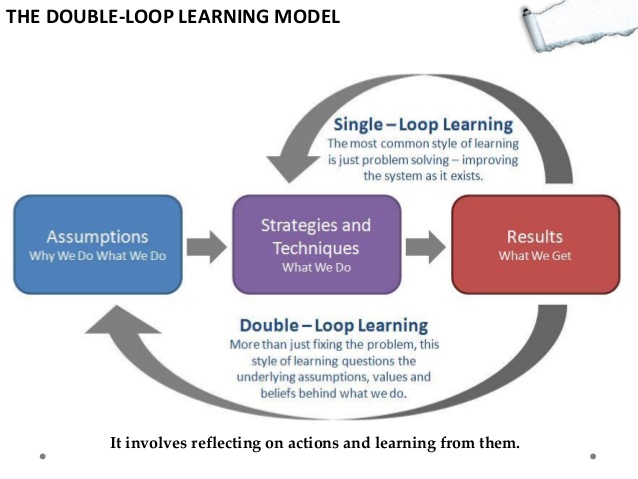
THE DOUBLE LOOP LEARNING MODEL

HOW TO LEARN FROM MISTAKES

Double loop learning involves reflecting on your actions and learning from them. The theory is based on the work of the system. Theoreticians Heinz von Foster and Nicholas Luhmann. In particular on the idea of second-order observations. Strictly speaking this is not a model but a technique for know it alls. How can you master this desirable outcome. Simple you learn how to observe first-order observers. 

First-order observers say things that appear to them, for them the world is simply that there. Second-order observers on the other hand attribute what the first order observers see how they say it. In other words second-order observers observe a way of observing. 
For example you criticise a football referee them making a wrong decision, you are a second-order observer, your perspective is different from the referees because you're one step removed from the game, and not actually calling the play and you think that makes you a better judge. 

During the act of observing first-order observers unaware of their own way of observing, it is their blind spot recognising this blind spot enables second-order observers to become know it alls. They are able to point out the first-order observers that is possible to observe differently that seeing things differently. 

Lazy salesxpert Julie SulterThe psychologists Chris Argyris  and the philosopher at Donald Schon developed double loop learning out if theoretical ideas on observation. In the best case scenario that the single loop. The first order (the first order observation). is best practise. Something that works well is not changed, but simply repeated. In the worst case scenario it is the worst practice. The same mistake is repeated our problems is solved without questioning how it arose in the first place. 

In Double loop learning you think about and question what you're doing and try to break your own pattern by not doing something differently, but by thinking about why you do it the way you do it. But the objectives and values behind your actions. If you're fully aware these you may be able to change them.

The problem inherent in double loop is a discrepancy between what we say where about to do (known as espouse theory) and what we actually do (known as theory in use). If we really want to change something it's not enough to create guidelines for our employees or ourselves or to give it directives. These only reach us as a command theory (Espouse theory). Real changes occur when we reassess our more rooted reasons, objectives and values. There are the ‘force fields’ that affect the theory in use.

Be the change you want to see.


THE MASLOW PYRAMIDS

WHAT YOU ACTUALLY NEED WHAT YOU ACTUALLY WANT. 
Lazy salesxpert Julie SulterThe three most important questions begins in the 2003 German film. How Hierankl
‘Are you having sex? Do you have a family? Are you intellectually stimulated? Scoring 3 yeses is paradise. 2 yeses is what you need to be happy, a one yes is what you need to survive.

The filming spy but the questions that are so good. In 1943 the psychologist Abraham Maslow published a hierarchy of needs model. He categorised human needs is following. 

Psychological (meant eating, sleeping, warmth, sex).
Security (Somewhere to live, health protection, against adversities).
Social relationships (friends, partner, love).
Recognition (status power money). 
Self actualisation (Individuality realising personal potential but also faith and transcendence).

The first three are basic needs. If they are satisfied, a person no longer thinks bout them.  The two are satisfied, a person no longer thinks about them.

They can never really be satisfied a person no longer thinks about them. The last two becomes interesting if we contrast our aspirations or personal growth needs, they can never really be satisfied. The pyramids model becomes interesting if we contrast our aspirations our needs.


Rule of thumb for the Western World: The things we desire the most are the things we need the least.

THINKING OUTSIDE THE BOX

HOW TO COME UP WITH BRILLIANT IDEAS

Lazy salesxpert Julie SulterA really innovative idea- rather than and old idea that has been applied to new context, or a variation of an existing idea or variation of an existing idea is rare.

Innovative ideas usually emerge when we leave our comfort zone, or when we break the rules.
The example used here is the nine point problem, which first appeared in puzzle magazines at the beginning of the twentieth century.

The task: Connect the nine points using a maximum of four straight lines without lifting your pen from the paper.
The solution: the trick is to extend the lines outside of the box. 

This puzzle is often as an example of the creative thinking but don't jump to any rash conclusions because Dr Peter Suedfield made an interesting observation he developed the restricted environment stimulation technique. REST. Which involves a person spending time in that Darken room, no visual artistry stimulation.

Sued field noticed that the subjects experiment didn't go mad. On the contrary: their blood pressure went down, their mood improved and they became more creative.


The person who wants to think outside the box, is better off thinking inside the box.