Saturday, 17 September 2016

What happens if nothing happens anymore?

Lazy salesxpert Julie SulterWhat happens. If nothing happens anymore. What is the engine of history. There is a rock to theories that deal directly or indirectly with this question. Thomas Hobbes believed in the survival instinct, Adam Smith in self interest, Karl Marx in the class struggle. George Wilhelm Frederick Hagel said the engine that led us from primeval tribal society through serfdorm to democracy was the struggle for recognition. According to his philosophy historical development is about the recognition of the individual. History ends in a state without political contradictions in which the human desire for recognition is satisfied. In the liberal democratic state. (Karl Marx approach was similar but the development he described had a different name a communist and classless society, which is not based on the principle of recognition but on redistribution). Hagel believed the end of history had been reached in 1806 When Napoleon defeated Prussia in the battle of Jena, which signified the triumph of the French Revolution and the aristocracy. Fredrich Nietzsche was also influenced by Hagel. He called a person who receives recognition in the Hegelian sense 'the last man'. Everyone wants the same, everybody is the same whoever feels different goes voluntary into a mad house. We have invented happiness say the last men and they blink. 
 In the 1990’s the American political scientist Francis Fukuyama ceased the notion all of the end of history and proclaimed that it had materialized the end of the Cold War since only one system had survived. Liberal capitalism. He was severely criticized. His critics called terrorist attacks of September 11 the end of history. Fukuyama was refuted most convincingly. By the facts the great powers such as Russia and China remained authoritarian states. Which have little in common with liberal democracy. But still become ever  richer thanks to capitalism. Fukuyama defeated this argument pointing to the fact. That even the recent financial crisis have not resulted in a fundamental change of the capitalist economic system and that even more recent revelations that uprising in Arab countries were inspired by western liberal values. In short history is still at an end. 
So what next? Fukuyama predicted an age of boredom. Once history had ended the terrible feeling that in a world without contradictions in which everything is possible nothing has value anymore what are the possible consequences. 
History could start again or repeat itself. 
A return to nationalism, as crisis driven Europe indicates. 
A renaissance of communism.
A step towards a New World order. 


It is completely wrong to imagine. That Arab revolutionaries want the same liberal capitalism that exists in the West. Slavoj Zizek

Thursday, 15 September 2016

THE RESULT OPTIMISATION MODEL

Lazy salesxpert Julie Sulter
Why the printer always breaks down just before a deadline.

There are many project management models and methods, most of them are based on the premises that there is a fixed amount of time in which to carry out a project.  Generally within this time ideas are gathered, the GM consolidated and a concept is selected and implemented. In the eye of the real life we all know that we never have enough time and the little time we do have is reduced by unforeseen events, like a printer breaking down the minute you want to use it. The result optimisation model device takes available time in 3 sequences loops of equal length. Thereby forcing the project manager to complete the project 3 times. The idea: to improve the outcome in each successive loop. Working with this model leads not to only improved output quality, but also has a more successful final outcome. At the end of a project instead of simply being glad that it is finally been put to bed, the whole team has a threefold feeling of achievement. Beware the stringed instrument when carrying out the strategy: work in such a way that each loop is properly completed before embarking on the next, otherwise this model loses it's dynamic with development processes. It is important to separate the three stages of gathering, consolidation and implementation.

A beautiful thing is never perfect Anonymous

Wednesday, 14 September 2016

THE ROLE PLAYNG MODEL BELBIN AND DE BONO


Lazysalesxpert Julie Sulter
How to change your own point of view. When the creative thinking Guru Edward De Bono presented his Six Thinking Hats in 1986 critics dismissed the idea as just a bit of fun. De Bono's idea was to assign the members of a working group a temporary one dimensional point of view. Today the technique is widely accepted and De Bono's six hats are used as a team meeting technique to simulate communication and create playful scenarios. How it works, strategies are discussed by the members of a group during the discussion all members are given a hat colour with a personality to match. Each of the six points of view of the colour hat are important. All members of the group where the same colour hat at the same time these are the characteristics associated with each colour white hat analytical objective thinking the emphasis on facts and feasibility, redhat emotional thinking subjective feelings perceptions and opinions, blackhat critical thinking risk assessment identifying problems scepticism critique, yellow hat optimistic thinking speculative best case scenario, greenhat creative associate thinking new ideas brainstorming constructive, blue hats structured thinking process driven the big picture. Beware the meeting must be moderated to ensure the team members do not slip out of their designated roll. Teams in which the members have similar views and character traits don't work as well. If you have a good idea but fear it may meet with strong resistance try to lead the discussion in such a way that the other members of the group think that they came up with the idea themselves the more people feel that they have originated an idea the more passionately they fight for its implementation. If nobody claims to have come up with the idea, perhaps it wasn't a good idea in the first place.
 I never did anything alone, what was accomplished was accomplished collectively Golda Meir

Tuesday, 13 September 2016

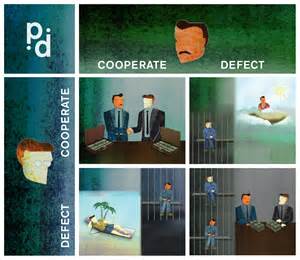
THE PRISONER'S DILEMMA

Lazy salesxpert Julie SulterWhen is it worth trusting someone? as the saying goes trust makes way for treachery but it is true.
Here is a puzzle that provides an answer.
Two prisoners are suspected of having carried out a crime together the maximum sentence for the crime is 10 years. The two suspects have been arrested separately and each is offered the same deal,  If he confesses that they both committed the crime and his accomplice remain silent, the charges against him will be dropped.  But the accomplice will have to serve the full 10 years if both he and his accomplice remain silent. There will only be circumstantial evidence which nonetheless puts both men behind bars for 2 years. But if both he and his accomplice confess to the crime they are both to be sentenced to 5 years in prison.
The suspects cannot confirm how should they react under questioning. 
Should they trust each other?
This is the so-called prison dilemma a classic conundrum in game theory. The two suspects both lose if they opt for the most obvious solution, ie put themselves first they get a 5 year sentence each.
Far better if each one trusts one another.  If they remain silent then they get a 2 year sentence. Note: If only one of the suspects confesses then the sentence is 10 years for the other suspect the confessor is freed.
In the 1979 the political scientist Elroid Rod organised the tournament in which 14 academic colleagues play 200 rounds of the prisoner's dilemma against one another in order to work out the best strategy. He found that in the first round it is best to co-operate with your accomplice, trust him in the second round. Do what your accomplice did in the previous round by initiating his moves he will follow you.

 You can't shake hands with a clenched fist, Gandhi

Monday, 12 September 2016

THE TEAM MODEL

Lazy salesxpert Julie SulterIs your team up to the job regardless of whether you are the head of a nursery or a national sports team. Whether you want to set up a company or fundraising committee you'll be asking yourself the same questions do I have the right people for this project? do the skills correspond to our goals? are we capable of doing what we want to do? 
The team model will help you to judge your team beginning by defining the skills expertise and resources that you think are important for carrying out the project.
Note the skills that are absolutely necessary for the job distinguish between soft skills 
EG loyalty, motivation, reliability and hard skills EG computer business and foreign language ability.

 For each skill define where your critical boundaries lie on a scale of 0 to 10 for example an acceptable level of fluency in French might be 5/10. Judge your players according to these criteria, connect the point with a line. What are the teams weaknesses and what are their strengths? even more revealing than the model itself is a subsequent self-evaluation by the team members. A good team is one that can correctly judge's own capabilities. Beware real strengths lie in differences not similarity. The best executive is the one who has sent good enough men to pick men who do what he wants done.

Sunday, 11 September 2016

THE STATUS MODEL

Lazy salesxpert Julie SulterHow to recognise a winner whether you wish you had been born into privilege or just a little richer we all have social aspirations that how can we recognise class distinctions of social status and model over the next page has two axes how you spend it and how you earned it.
The Matrix we define 4 types.

Old money the established Elite can be characterised by their dogged adherence to old school conventions in the face of a changing world they drive two identical rolls royces for fear of otherwise appearing to showy. They donate millions to charity to soothe their consciences. There is a touch of the ridiculous about them.

Children of rich parents sound like a broken record searching for identity that never was good for nothing, they should be routinely ignored.

The Nouveau riche
Spend their money like there's no tomorrow- as conspicuously as possible so that everyone notices the status symbol of this group is the monster SUV however their propensity for hysteria suggest that it could all be over soon.

The green SUV
The creative career, organic lifestyle and the green SUV proclaim an alternative globalisation in which good conquers evil but this sustainable way of life is motivated less by bad conscience than personal advantage. The green SUV is do not forgo luxury because nowadays luxury is green the metaphor of this new Elite is the green SUV: sustainable luxury.

The poor wish to be rich, rich wish to be happy the single wish to be married and the married wish to be dead. Ann Landers

Friday, 9 September 2016

THE HERSEY BLANCHARD MODEL (SITUATIONAL LEADERSHIP)

Lazy salesxpert Julie SulterTHE HERSEY BLANCHARD MODEL (SITUATIONAL LEADERSHIP)

HOW TO SUCESSFULLY MANAGE EMPLOYEES

Over the last hundred years organisational theory has taken many different tunes. man is a machine and should be treated as such (Taylor Ford). Paying attention to social factors, and not objectively regulated working conditions, leads to th best results (Hawthorne). Organisations can regulate themselves (Clarke, Farley). A strategic management, i.e. division of the organisations into primary and secondary activities, leads to success (Porter).
A rather different theory was put forward by Paul Hersey and Ken Blanchard, who suggested that the most important thing is to adapt one’s style of leadership to the situation at hand. This ‘situational leadership model’ distinguishes between:

  1. Instructing. When they are starting a job, employees need strong leadership. When they are new their level of commitment is usually high, but their level of expertise is still low. Employees are given orders and instructions.
  2. Coaching, The employees’ level of expertise has risen. Because of stress and loss of initial euphoria at starting a new job, their motivation and commitment levels have fallen. The employees are asked questions, and they look for answers themselves
  3. Supporting. The level of expertise has risen sharply. The level of motivation can vary: either it has gone down (employees may resign) or it has gone up as as a result of being given more independence (employees are encouraged to come up wit their own ideas).
  4. Delegating. Employees are fully in control of their work. The elev. of motivation is high. They are given their own projects and lead their own teams.